
Vacuum principle

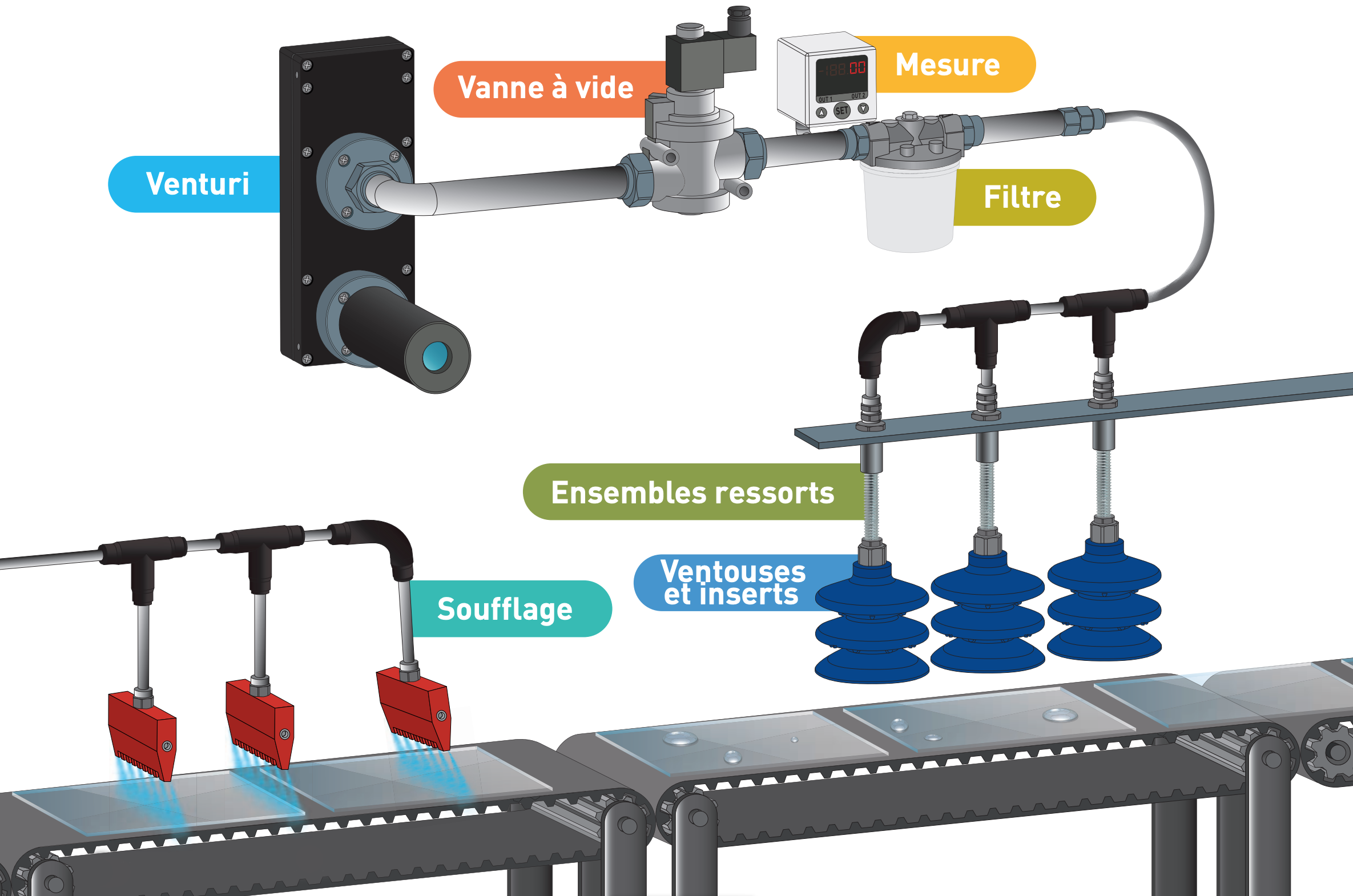
The vacuum gripping ensures the handling of a multitude of objects without damaging them and allows for high rates of vacuum transfer. Vacuum handling is a technique widely used in the manufacturing industry (automotive, food processing, plastics, pharmaceutical, packaging, printing, etc.). It involves grasping an object - which can be a sheet of metal, a sheet of paper, a finished product, or food - using suction cups or clamps, to transport it from one workstation to another or to place it in its packaging, for example. The suction cups are integrated into a handling device, and the vacuum is ensured by a circuit controlled by automation and powered by vacuum generators, also known as venturis or ejectors.
The vacuum, also called "negative pressure" or "suction," is created when the pressure is lower than the atmospheric pressure exerted by the weight of the ambient air.
Atmospheric pressure becomes a source of energy when the pressure is reduced in a closed space.
Beware of the influence of altitude. Atmospheric pressure varies depending on the altitude at which the implementation takes place.
In science, the vacuum is measured using what is called absolute pressure. The reference point is absolute zero, thus an air-free space, and its value is preceded by a positive sign.
In practice and for industrial applications, relative pressure is used. The vacuum is indicated relative to the ambient pressure. The vacuum value is preceded by a negative sign because the ambient pressure, as a reference point, is considered to be equal to 0 bar.
VOLUME AND FLOW
Giving the volume of a quantity of air is meaningless unless the pressure and temperature of this volume are specified. This is why so-called "normal" conditions have been defined to unify this value.
The ANR conditions (Normal Reference Atmosphere) are: Temperature = 20°C = 101.325 kPa = 1 bar and humidity = 65%. The vacuum volume is then noted as Nl and is read as "normal liters."
The definition adopted for normal volume extends to flow rates. The flow rate of an air volume passes through a section per unit of time. To express the suction capacity or air flow rate, we speak of "normal liters per minute" or Nl/min.
UNIT OF MEASURE
The vacuum is expressed as a percentage (%) of atmospheric pressure.
Several units are used to designate pressure lower than atmospheric pressure: the bar (bar), the millibar (mbar), or the percentage of atmospheric pressure (%). One may also encounter the kilopascal (kPa), the torr or millimeter of mercury (mmHg), the kilogram-force per square centimeter (kgf/cm²), and the pound per square inch (psi).
| EXPRESSIONS | UNITS | |
|---|---|---|
| Depression | -kPa | bar |
| Absolute pressure | inHg | mmH2O |
| % of vacuum | mmHg | torr |
| Negative pressure | hPa | mbar |
1 mbar = 0.001 bar = 0.1 kPa = 0.75 mmHg = 0.01 psi.
PRESSURE/VACUUM CONVERSION TABLE
| ABSOLUTE RESIDUAL PRESSURE | PRESSURE LOWER THAN ATMOSPHERIC PRESSURE | ||||||
|---|---|---|---|---|---|---|---|
| MBAR | VACUUM (%) | BAR | PSI | KPA | TORR,MMHG | KFG/CM² | HG |
| 900 | 10% | -0.101 | -1.45 | -10.1 | -76 | -0.103 | -3 |
| 800 | 20% | -0,203 | -2,9 | -20,3 | -152 | -0,207 | -6 |
| 700 | 30% | -0,304 | -4,35 | -30,4 | -228 | -0,31 | -9 |
| 600 | 40% | -0,405 | -5,8 | -40,5 | -304 | -0,413 | -12 |
| 500 | 50% | -0,507 | -7,25 | -50,7 | -380 | -0,517 | -15 |
| 400 | 60% | -0,608 | -8,7 | -60,8 | -456 | -0,62 | -18 |
| 300 | 70% | -0,709 | -10,15 | -70,9 | -532 | -0,723 | -21 |
| 200 | 80% | -0,811 | -11,6 | -81,1 | -608 | -0,827 | -24 |
| 100 | 90% | -0,912 | -13,05 | -91,2 | -684 | -0,93 | -27 |
APPLICATION